
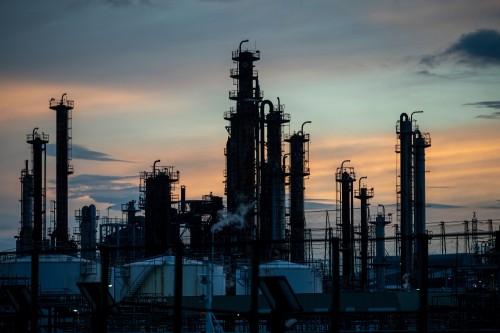
Oil prices surged on Monday as tensions escalated in the Middle East, raising inflation concerns and speculation that central banks might hike interest rates. Brent crude, the global oil benchmark, climbed to $111.16 a barrel, marking its highest point in nearly two weeks, following a nuclear power plant attack in the United Arab Emirates. This development coincided with stalled peace talks between the United States and Iran, now in their sixth week of ceasefire negotiations. Former President Donald Trump heightened the urgency with a social media post warning Iran that “the Clock is Ticking” and urging swift action. Iran later stated it had responded to a new U.S. proposal to end the conflict, causing Brent crude to ease back to $110 a barrel.
The bond market experienced volatility, with the U.S. Treasury’s 10-year yield hitting 4.631%, a high not seen since February 2025, before settling at 4.599%. Meanwhile, in the UK, uncertainty surrounding Prime Minister Keir Starmer’s leadership contributed to fluctuations in government bonds. The 10-year gilt yield peaked at 5.19%, surpassing an 18-year high reached the previous Friday, before retreating to 5.15%. Speculation about Manchester Mayor Andy Burnham potentially challenging Starmer’s leadership added to the instability. UK Chancellor Rachel Reeves and other G7 finance ministers gathered in Paris to discuss the economic repercussions of the Middle East conflict.
Analysts expressed concerns about the UK’s fiscal outlook. Mohit Kumar, Jefferies’ chief economist, noted that investors were wary of a potential “shift to the left” in UK politics, which could lead to increased public spending despite limited fiscal capacity. He warned that further tax hikes might not generate additional revenue. Kathleen Brooks, XTB’s research director, suggested that UK bond yields might recover if markets believed Burnham’s influence on spending could be restrained. The key test for UK markets would be whether the 10-year yield could fall below 5% and if confidence in Burnham could alleviate pressure on long-term yields.
Globally, bond yields rose in Japan, with the 10-year yield reaching nearly 30-year highs at 2.8% as the government prepared to issue new debt to mitigate the economic impact of the Middle East crisis. European stock markets opened lower, with the Stoxx Europe 600 index dropping 0.7%, while the UK’s FTSE 100 remained relatively stable. In Asia, Japan’s Nikkei index fell by about 1%, Hong Kong’s Hang Seng index declined by 1%, and Shanghai’s SSE Composite slipped by 0.1%. Conversely, South Korea’s Kospi index closed 0.3% higher, reflecting varied regional responses to the unfolding geopolitical situation.
